Tana Toraja – A journey into the Celebes Highlands  

Posted by Romario Mile

My journey into South Sulawesi started one-hour North of Makassar (Ujung Pandang) with a visit to the Valley of Butterflies. It was a Sunday, which meant I would be sharing this place with many families. At 10.00 am there were already hoards of people picnicking and playing loud music from speakers.

Luckily they didn’t carry their loud music along the trail and I was able to enjoy a quiet nature walk alongside the river, and find some of those elusive giant butterflies, which are attracted to this valley. The trail ended at a series of dark caves and with the aide of a lantern I went on a bit of a hunt for bats and other treasures. The reprieve from the hot sun was a welcome relief.

I continued my journey on the long highway leading north out of Makassar. This road takes you on a timeless journey into Tana Toraja.

Toraja has fascinated people for centuries with their elaborate sacrificial funeral ceremonies and sacred burial cave sites guarded by effigies. The colorful hand painted houses called Tongkonans are beautifully decorated in tribal motifs and buffalo horns from past sacrifices. The origins of Torajan culture dates back in celestial time as the Torajan people believe they descended from the stars and arrived in starships. It is thought that the shapes of their houses resemble these very starships.

That night I stopped in the township of Parepare and slept the night overlooking the Straights of Makassar from a hotel perched on the top of a hill with fantastic views.

The next morning I continued north into the mountains. About 5 hours later I arrived in Rantepao – the heartland of Toraja country. The road winds higher and higher into the mountains and at the summit you reach a place called Butu Kabobong, which means Erotic Mountain. There before you lay two erotic geological landmarks, which introduce you to the gateway of Torajaland. To the local people they are known as ‘Most Holy Penis’ and ‘Most Sacred Vagina’.

This is the point where the Torajan people claim their first ancestors descended from Pleiades in starships. Another belief is that the Tongkonan houses resemble a boat-shaped design to allow for the soul of a dead person to be launched back to the stars.

The tongkonans are built without nails and are simply slotted together with precise accuracy and are built with lifetime strength. Their houses and rice barns stand on stilts allowing for free flow circulation from below and also double as a shelter for the family owned water buffalo. The slatted floors allow for animal droppings to be collected and reused for crop fertilizer.

The next day my local Indonesian (English speaking) guide called into an internet café to check his email. He appeared 5 minutes later with a big smile on his face “We are lucky, Miss, even though the funeral season is usually June and July, there is a funeral in progress only 30 kms from here. It is day 3 of the funeral and will be the most interesting day – The day of the animal sacrificing”.

Torajan funerals are held only when the families have saved enough money to host the elaborate event. It is necessary to build a complete village to house literally hundreds of guests over a 5-day period. The temporary village is then dismantled afterwards. The other major cost involves buying animals for sacrifice.

One healthy buffalo can cost up to 40 million rupiah (US$3,300) and a pig can cost up to 3million rupiah (US$250). It is not uncommon to have over 50 pigs and several buffaloes sacrificed. For this reason, the dead body may end up staying in the house for up to five years or more to await the accumulation of finances.

One of the traditional villages I visited actually had a five-year-old mummified body laying in the lounge. The dead person was an elderly female, whose husband had died previously and the family were still unable to pay for a second funeral even five years later.

Toraja Country

Some of the mummified bodies are stored in ornately decorated sarcophaguses. If you are from royal descent, then a royal widow must stay in the same room as the dead spouse until the burial time. It is not uncommon for a widow to stay up to five years or more. The widow must stay with the disintegrating corpse and sympathically “rot” herself, living on a special diet for the entire period, excluding rice products. She must become symbolically dead. She is not permitted to leave her husband’s side. Lesser widows and slaves tend to her needs. To make sure the soul is not neglected, a bowl of food is replenished daily and palm wine poured plus an offering of betel nut or chewing tobacco is made at regular intervals. The Torajans believe it is only through this rich ritual that they will always be a ‘free soul’ and become richer in their next life.

It was around 35 degrees and hot at 10.00am when I arrived at the funeral. Sada, my guide, escorted me along the 1 km rocky trail to reach the temporary bamboo village, which had been erected, for the sole purpose of this burial. I was made to feel very welcome and was told I could take as many pictures as I liked. If foreigners come to a traditional Torajan funeral it is seen as a sign of good luck and in the hierarchical order of status, a foreigner is seen as a dignitary, and thus you are treated as an honored guest. I had many offers of coffee (home grown Torajan coffee, which is famous to the area), cakes and other sweets. The people were very friendly and I was made to feel very welcome and invited to sit in the "family room".

The Torajan society is a highly structured one, with 4 classes of people, from nobility down to peasant class. Depending on your ranking in the village, you must offer a certain amount of pigs or buffalo, which is then slaughtered, and the meat distributed evenly amongst the guests, depending on their ranking in the village society.

An official from the Government, who writes in triplicate, records every animal given for slaughter and a tax is imposed accordingly. I sat in amazement, taking all this in, from the cool shade of the family platform, talking with the locals about their life, their work in the city, their travels etc. Family members come from all corners of Indonesia when a funeral is in procession, and many of the local guests spoke fluent English. In fact, a nobleman’s son or daughter will have an assistant assigned to him from birth to accompany him in his life. This includes attending school in Makassar or further a field to Jakarta or even overseas in some cases.

The animal sacrificing had already begun when I arrived. It took place in a specially designed area where pigs and other animals where hauled in to the “circle of death” and killed with great speed and efficiency. Blood flowed through the middle of the common area and huge chunks of meat were weighed and divided out throughout the day according to ranking and status. A few bamboo pipes went past me, full with animal blood, but I didn’t dare ask what they were for, or where they were going. I checked my tea was actually tea.

I felt very privileged to attend this funeral and in the afternoon returned to the luxury of the Heritage Hotel (previously Novotel). A magnificent 160-room 4 star property, including villas designed in the shape of Tongkonan houses. The hotel had all the finishing touches including a wonderful meet and greet service, on arrival with cold towels and a relaxing head and shoulders massage.

Due to a current downtown in tourism, as in many Indonesian destinations, I was able to visit the villages and interesting sights in virtual solitude. Hotel occupancy at the Heritage was only 10%. Next on the agenda was a visit to a few death cliffs. This is another fascinating aspect of the culture. The Torajans bury their dead in chiseled out coffin slots in cliffs, or on rocks or hillsides. Some have effigies placed in the open doorways to guard the spirit of the dead body. Some are just left open, exposing the bones for all to see.

On day 5 I decided to take a 2-hour drive to a distant village. I arranged, through my guide, to stay in a traditional Tongkonan longhouse in a small village perched high in the mountains.

It was late afternoon when I reached the high road that would lead me to this village. The light was beautiful and I decided to get out of the car and walk the last 4 kms. This gave me the opportunity to meet and talk with the local mountain folk who were out walking along the roadside. Sada, explained the procession of people out walking were on their way back to their villages after a funeral. It was also a school day, so there were many children as well, out walking on the road. It is not unusual for children to walk 8 -12 kms to and from school each day! The children were fantastic, smiling and laughing and having fun posing for the camera.

The mountain people of Toraja have very distinct features. They look different to any other tribal indigenous people I have seen in Sulawesi. They resemble Siamese or Cambodians more so than Malay Indonesians. I noticed that even though these rural people live in basic houses, with very poor conditions they are always happy, smiling and relaxed, seemingly without a care in the world. In terms of materialistic acquisition, which many of us in the West aspire to, the Torajans seem happy to live in a very simple way, not wanting for much. Their most important asset is a large healthy buffalo. When I arrived at the Tongkonan house for the night, I had a choice of which attic I wanted to sleep in. I was told the room rate would be a grand total of USD$4.00 including a pancake breakfast!!

The owners of the home stay cooked a beautiful dinner, and I dined that night overlooking the beautiful mountains of Toraja with a view of the full moon. It was more than enough to make up for the slight discomfort of sleeping on simple mattress on the floor and taking a traditional stand-up cold mandi (bath).

The next morning I awoke to find I was above the clouds. I descended down into the misty valley where the next adventure awaited me - white water rafting.

I had to walk about 1 hour through a series of rice fields and some forested areas to the “put-in” on the riverbank. The mountains views were simply stunning in all directions, and in the distance on the far side of the river was a series of large waterfalls.

The rafting trip down the river was an adrenaline boost and a wildlife extravaganza. I saw several male iguanas sunning themselves on rocks, cruised into a bat cave and spotted around 30 bats, observed several species of bird life, including eagles and passed several towering waterfalls that cascaded down from the steep mountainous terrain. After a pretty exhausting day I slept well in the luxury of the Heritage Hotel.

It was a 7-day trip in total and for anyone who wants to experience a fascinating culture, set in a beautiful mountain environment then Tana Toraja and its riches lay waiting for you.

Text Stephanie Brookes
Photos David Metcalf

PRACTICALITIES

Getting There:
Garuda Airways Tel: (04110 317350, 322 705
Daily flights from Jakarta to Makassar Intl Airport
Information: Government Tourist Information: Tel (0411) 443355
Hotels: Panti Gapura – Makassar Tel (0411) 325 791
Heritage Hotel (formerly Novotel) Rantepoa Tel (0423) 27000, 21192
Tongkonan Homestay – arranged by Pak Sada (private tour guide)
Tour Guide – Pak Sada (0411) 458 322, Handphone: 0812 4222800
Rafting – Sobek Rafting Company Tel: (0423) 23010, 21336
Kampung Sampireun A Natural Beauty Hideaway  

Posted by Romario Mile


Imagine yourself in the mountains with 7 volcanoes surrounding you. You are sitting on a private balcony overlooking a lake. There is a quiet stillness around you. You are at peace with everything and in the distance the sound of Sundanese Gamelan music lulls you into a relaxed state of mind. This enchanting experience awaits you every day at Kampung Sampireun. It is a total hideaway in nature and offers you resort living with a real difference.

The journey to get to Kampung Sampireun, if you are coming from Jakarta, starts with a train journey – “one of the most spectacular train journeys in all of Asia”, according to Lonely Planet.


I can highly recommend the train. Of course, you can easily drive from Jakarta to the resort if you wish, but the train journey is an interesting way of getting there. After you arrive at Bandung train station it is a 2 hour drive to your final destination – a small town just out of Garut.

Train Journey Jakarta to Bandung

The executive train, called the Argogede, departs promptly from Jakarta at 10.00am. The train is clean, with modern facilities, (even a western style toilet) and a good food selection on board served by very friendly railway staff.

The first one hour is mainly flat as you make your way through the outer suburbs of Jakarta. About 1 ½ hours into the journey the mountains come into view and the Argogede begins its ascent. The vegetation changes and becomes more lush and green. You catch glimpses of banana plantations, cassava crops and beautifully sculptured rice terraces as the train curves and winds around the mountain. The most spectacular part of the journey is where it crosses a series of railway bridges with stunning views as you pass over gorges and valleys. As the train clatters over the high railway bridges you look down on the thundering river hundreds of meters below.

You can enjoy all this for the very reasonable price of 75,000 rph (US$9). What a bargain!


Hotel Tirtagangga

Once you have arrived at Bandung Train Station the next part of the journey is a drive of 2 ½ hrs to Cipanas township. Cipanas is one of the small towns around the Garut area, which was a popular place for the Dutch colonists last century. Seeking escape from the heat they would come up to this mountain area for the cool weather, the dramatic volcanic setting and the natural hot springs.

A very worthwhile stop is the very popular Hotel Tirtagangga, which pipes pure (hot) water from its own natural spring into the swimming pool for hotel guests and day visitors alike. You can take a rest and enjoy a soak in the natural healing waters in the hotel’s aqua medi pool which is surrounded by beautiful tropical plants and flowers.

This hotel has an interesting history in itself. It has been a family owned hotel since 1964. Mr Arief’s family purchased the natural spring when the Dutch left Indonesia in 1945. The family then began to work on their dream to build a natural spring hotel. Hotel Tirtagangga was fully renovated 2 years ago and now has 40 rooms, all with natural (hot) spring water piped directly into each bathroom.

Mr. Arief told me they get “many clients from the embassies and oil companies”. Their foreign guests tend to come from the Netherlands and Germany, “Most of them come here on business, stay on afterwards and somehow get to hear about our hotel. They usually stay a couple of days”.

The other appeal of this Garut area is the opportunity to trek or bike in the mountains, take a 4wd adventure into the back country or for the real adventurous, take advantage of the local river rafting trip which , according to Mr Arief , “is the cleanest water in all of Java”.

Kampung Sampireun

After our hot springs stop, we continued on another 11 kms to our final destination – Kampung Sampireun. It is here that nature meets and blends with this unique idyllic natural retreat.

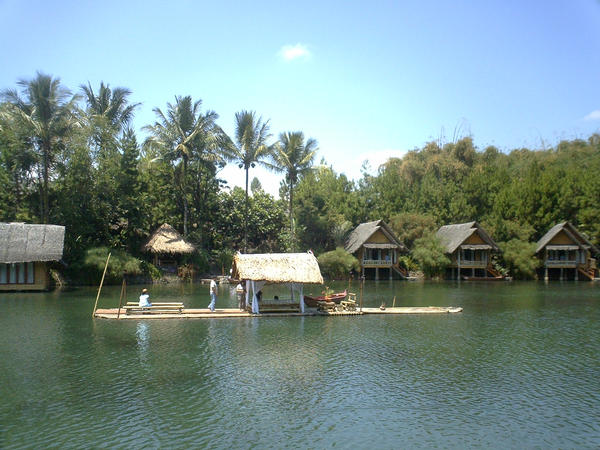
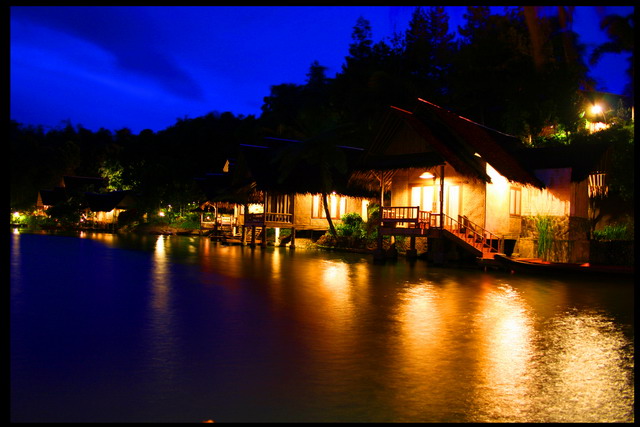
If you can plan to arrive at night, you will be in for a magical experience. First, you enter through a kampung and on arrival at reception, you are graciously greeted by the staff in traditional sundanese dress and given a special welcome drink called “bandrek”, made from a traditional recipe. The lobby opens out onto a small wooden jetty. When you step onto the jetty you are treated to a spectacle of color and lights which surround the lake edge and adjoining forest. Dotted around the lake are cottages which sit on stilts in the water. All 13 cottages are softly lit up to create a charming atmosphere. On the other side of the lake a small fairy lit path leads to the restaurant. Your bags are quietly whisked away and you are then taken by canoe to your cottage.

From now on everything is by water. Room service is by canoe. A restaurant booking involves a canoe arriving at your waterfront cottage to take you across the lake to dine.

For honeymooners, a dinner by candlelight can be organized on a floating bamboo raft, which sits out in the middle of the lake. Even if you are not on honeymoon, and you fancy a unique dining experience, Pak Rudi, the manager will organize this for you. You can even order your dinner in advance, so when you are rowed out into the middle of the lake, your food awaits you. You are then served discreetly and left alone floating on your candlelit raft for what can only be described as an unforgettable dining experience.

Around sunset, a traditional sundanese orchestra, called a ‘Calung’, floats around the lake serenading those who are relaxing on their balcony. Dressed in traditional style, wearing the ‘barangbang semplak’, it is quite a sight to behold, and no matter where you are at sunset, the music carries softly across the water and can be heard from any area of the resort. The orchestra appears later in the restaurant and entertains you for the entire evening. It is a delightful, subtle kind of music that is very soothing and really adds to the ambience of the resort.

For a treat in total luxury, you can try one of the treatments on offer at the Taman Sari Royal Heritage Spa. This is set in the tropical landscaped gardens of the resort and features a never ending pool for those who like to unwind at the poolside.

The rooms

The resort was designed by Mr Djembar Nugrah, a local Garut architect. He was inspired by a photograph of the 1940 Hotel Radium, which no longer exists. Together with Mr Arief, they have created a beautiful resort, which they have blended with tradition, culture and kampung life.


All the materials used at the resort are sourced locally. The cottages are made out of bamboo with coconut roofs. The interior décor is also natural and beautifully furnished, with a nice touch of fresh flower petals spread across the 4 poster canopy bed.

Mr. Arief has owned this private lake for some time and developed it into a resort in 1999. The lake is surrounded by a naturally wooded forest. It also happens to be located in the middle of a kampung, hence the name.

Kampung life and life at the resort blend into one allowing for a totally cultural experience when you visit. The kampung rice fields are right behind the back fence, water buffalo can be seen ploughing the fields, and standing as a backdrop to this is a magnificent volcano. Kampung trekking is offered to guests who wish to gain some insight into local village life and other activities, including a kids fun program.

What is special about the resort is the unique blend of local traditional Sundanese culture and the beautiful idyllic setting. Discover a new experience and take a trip to this relaxing, tranquil place and allow yourself to unwind in a beautiful Javanese setting.

Fact File

Jakarta to Cipanas (by car) – 5 hours
Jakarta to Bandung (by express train) – 2 ½ hrs then another 2 ½ hrs to Cipanas
Hotel Tirtagangga – Jl Raya Cipanas No 130, Garut, West Java
Phone: (0262) 232549, 233700
www.hoteltirtagangga.gitamaya.com

Kampung Sampireun – Jl Raya Samarang – Kamojang, Ciparay Garut, West Java
Phone: (0262) 542393
www.kampungsampireun.com

Puncak  

Posted by Romario Mile


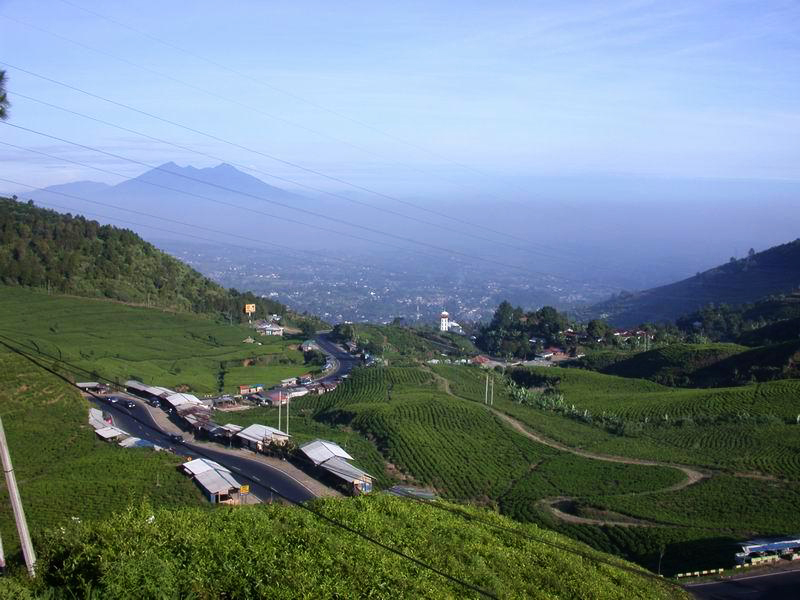
Between Bandung and Bogor in the mountains lays Puncak, a cool area, which is very popular. People from Jakarta spend their weekend and on public holidays from the heat and busy streets of the capitol of Indonesia to Puncak. Bandung to Puncak takes about 3 hours drive. Puncak Pass area has long been the foremost weekend retreat for Indonesians capital city residents. The cool, fresh air, and the magnificent view offer a calm, fresh and peaceful feeling. In the afternoon, sunsets from the top of the pass can be quite spectacular.

Puncak Pass is one of interesting destination in the West Java Province. It is located in the south of Jakarta and can be reached by an hour journey. Puncak is an ideal place for weekend, as well as a good location to find a fresh mountain air. Besides, many attractions can be found nearby, such as the Bogor and Cobodas Botanical Gardens; the Gede Pangrango National Park; the Plantations and the Safari Park.

Puncak Indah consists of three districts: Ciawi, Megamendung, Cisarua. The area is familiar with its fresh air and beautiful panorama. From Ciawi to Cipanas, there are many bungalows, hotels, motels, restaurants, and other tourism facilities. Tourisms object in Puncak is Lido Park, which is located in Cigombong village/Wates Jaya (km. 21) Rd. Ciawi-Sukabumi, Cijeruk. Facilities that are provided in Lido Park ara restaurant, cottages, swimming pools, camping grounds, and other facilities for lake recreations. Gunung Mas XII Plantation, which is located in Rd. Puncak, Cisarua district. It offers panorama with hilly panorama, which could only be found in Puncak. Activities that could be done are tea walk and seeing the making of the tea from the picking of tea until the tea is ready to serve.

Jakarta  

Posted by Romario Mile

JAKARTA

Jakarta is the capital city of the Republic of Indonesia, a country composed of more than 13,000 islands with a population of over 180 million. Comprising more than 300 ethnic groups speaking 200 different languages, the Indonesia population exhibits marked diversity in its linguistic, culture, and religious traditions. As the Capital City, Jakarta is a melting pot of representatives from each of these ethnic groups. Jakarta is a special territory enjoying the status of a province, consisting of Greater Jakarta, covering of 637.44 square km area. Located on the northern coast of West Java, it is the center of government, commerce and industry and has an extensive communications network with the rest of the country and the outside world. Strategically positioned in the archipelago, the city is also the principal gateway to the rest of Indonesia. From the Capital City, sophisticated land, air, and sea transport is available to the rest of the country and beyond.

Jakarta is one of Indonesia's designated tourist areas. It is a gateway to other tourist destinations in Indonesia and is equipped with all the means of modern transportation by air, sea, rail, or by land. It has the largest and most modern airport in the country, the most important harbor in Indonesia and is well connected by rail of good roads to other destinations in Java, Sumatra, and Bali. As Indonesia's main gateway, Soekarno-Hatta International Airport serves a growing number of international airlines and domestic flights. Jakarta is a city of contrasts; the traditional and the modern, the rich and the poor, the sacral and the worldly, often stand side by side in this bustling metropolis. Even its population gathered from all those diverse ethnic and cultural groups, which compose Indonesia, are constantly juxtaposed present reminder of the national motto; Unity in Diversity.

Finding its origin in the small early 16th century harbor town of Sunda Kelapa, Jakarta's founding is thought to have taken place on June 22, 1527, when it was re-named Jayakarta, meaning Glorious Victory by the conquering Prince Fatahillah from neighboring Cirebon. The Dutch East Indies Company, which captured the town and destroyed it in 1619, changed its name into Batavia and made it the center for the expansion of their power in the East Indies. Shortly after the outbreak of World War II, Batavia fell into the hands of the invading Japanese forces that changed the name of the city into 'Jakarta' as a gesture aimed at winning the sympathy of the Indonesians. The name was retained after Indonesia achieved national independence after the war's end.
The ethnic of Jakarta called "Orang Betawi" speaks Betawi Malay, spoken as well in the surrounding towns such as Bekasi and Tangerang. Their language, Betawi Malay, has two variations: conventional Betawi Malay, spoken by elder people and bred in Jakarta, and modern Jakarta Malay, a slang form spoken by the younger generation and migrants.

Jakarta's

architecture reflects to a large extent the influx of outside influences, which came and has remained in this vital seaport city. Taman Fatahillah Restoration Project, begun in the early 1970s has restored one of the oldest sections of Jakarta also known as Old Batavia to approximately its original state. The Old Portuguese Church and warehouse have been rehabilitated into living museums. The old Supreme Court building is now a museum of fine arts, which also houses part of the excellent Chinese porcelain collection of former Vice President Adam Malik. The old Town Hall has become the Jakarta Museum, displaying such rare items as Indonesia's old historical documents and Dutch period furniture. Its tower clock was once returned to England to be repaired under its lifetime guarantee, which up to now has already

lasted hundreds of years.

In recent years, Jakarta has expanded its facilities for visitors with luxury hotels, fine restaurants, exciting nightlife and modern shopping centers. It contains many tourist attractions such as Taman Mini Indonesia Indah (Beautiful "Indonesia in Miniature" Park), restored colonial period buildings, island resorts in the Pula Seribu (Thousand Island), and an extensive beach recreation complex called Ancol. "Beautiful Indonesia in Miniature Park" popularly called TMII "Taman Mini Indonesia Indah", built to portray the variety of cultures found within the many islands contained in the Republic of Indonesia, this open-air museum comprises the many architectural forms of arts and traditions of all Indonesia provinces. It is proof of the country's motto of Unity in Diversity as well as Freedom of Religion depicted in the houses of worship built on the grounds.

Jakarta has preserved its past and is developing for the future. Skyscrapers in the center of the city are part of a new look. Modern luxury hotels today cater to the discriminating visitors. Transport within the city is plentiful. Jakarta is the center of the nation's industrial, political and cultural life. It is home to many of the country's finest research institutes, educational facilities, and cultural organizations. Jakarta is uniquely the seat of both the national as well as the regional government.

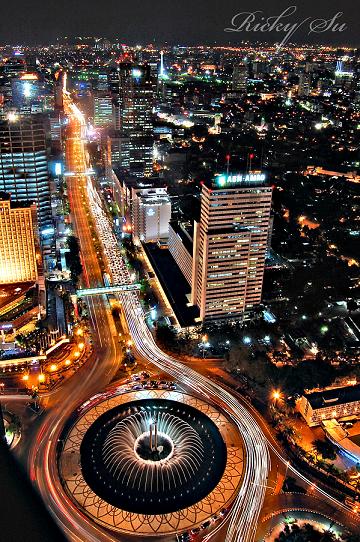
Over the last several decades, Jakarta has proudly developed into one of Asia's most prominent metropolitan centers. Today, Jakarta's skyline is covered by modern high rises. The many state-of-the-art shopping centers, recreation complexes and toll-roads have become hallmarks of the city. The quality of life and the general welfare of its inhabitants have improved considerably with the city's fast pace of development. Jakarta's cultural richness and dynamic growth contribute significantly to its growing importance as one of the world's leading capital cities.

Geographically
The Province is geographically located on 6012' South Latitude and 106048'- East Longitude. The government administration is set into 5 regions South Jakarta, Central Jakarta, East Jakarta, West Jakarta, North Jakarta and 1 regency/ administrative city, namely Thousand Island regency. The largest city is East Jakarta (187.73 sq km) and the smallest is Thousand Island regency (11.81 sq km). The average rainfall is 1,916.8- 924.50 mm/year. The temperature is between of 22 C - 33 C.

People
Indonesians are known as friendliest people in the world towards foreigners and most tolerant towards their manners. But there are few things, which are not done among Indonesia. They consider the head as something sacred that must be respected. Patting on the head is not done among adults. Calling someone by crooking the index finger is considered impolite and giving or receiving things with the left hand is no - where acceptable. The handshake accompanied with a smile is common among men and women greeting or welcoming somebody.


Not less 9 million people live in Jakarta representing nearly all the ethnic groups in the archipelago. The major groups are Sundanese, Javanese, Chinese, and the native community is Orang Betawi (people of Betawi). The other large groups are the Minangkabau people, the Bataks, the Manadonase, and the other people from Sulawesi and the Ambonase. Orang Betawi emerged in the 19th century from a melting pot of races, ethnic groups and cultures. They have their own culture distinct from other ethnics' cultures. In 1923 they founded an organization called Kaum Betawi, which was in fact a statement about the existence of the Betawi ethnic group. The majority professes is Islam. But it does not mean that Indonesia is an Islamic state. It is a Pancasila state. And one of the principles of Pancasila, the state ideology, is "belief in the one Supreme God". This means that the various belief systems must be respected and respect each other. This explains the ubiquitous Moslem prayer houses in the city beside many churches and a few temples.

In Taman Mini Indonesia Indah (Beautiful Indonesia in Miniature Park), the prince Diponegoro Mosque is juxtaposition with the saint Catherine Church, the Hallelujah Church, the Pura Penataran Agung Kertabumi Temple, the Aria Dwipa Arama Monastery and the Indonesian Mystic Convention Hall, symbolizing the motto: Bhinneka Tunggal Ika (Unity In Diversity) in matters of religions and belief - systems.

Betawi
Indonesia's cultural diversity is celebrated in the national motto, Bhineka Tunggal Ika, meaning "Unity in Diversity." One manifestation of this tenet of Indonesian national identity is the government's efforts to give equal precedence to the development of traditional art forms from each ethnic group. In Jakarta, Orang Betawi, the natives of the city, are considered to be the hosts of these cultures, having emerged from the melting pot of races, ethnic groups and cultures of Indonesia in the 19th century. Today they constitute one of the city's main ethnic groups along side the Javanese (from Central and Eastern Java), Sundanese (from West Java) and Chinese.

Culture
To see for themselves what and now those Betawi art forms are, we can go to any travel agent and ask for tour to a " Betawi Cultural Institution "to catch a glimpse of the real thing". Or we can visit the Jakarta pavilion at Taman Mini Indonesia Indah (Beautiful Indonesia in Miniature Park) which has long been showing Betawi ceremonies such as the Betawi wedding ceremony, the circumcision procession, the baby head - shaving ceremony etc. As mentioned before, the Betawi group emerged in the 19th century from the melting pot of races, ethnic groups and cultures. Today the Betawi culture has a distinct personality of its own, but one can discern the various influences of other cultures by looking or listening to its art form.

The Tanjidor orchestra is certainly inherited from Dutch land - owners and the Gambang Kromong and Cokek dance originated in the residence of wealthy Chinese traders and merchants. The Betawi Cokek dance shows Balinese influence in the movement of the dancers and the style of playing the gamelan. This style of playing the gamelan can also be observed in the gamelan orchestra accompanying the Wayang Kulit Betawi show. The Portuguese speaking community has also left its inheritance, the Kroncong Tugu with its popular songs Nina Bobo, Kaparinyo and Kroncong moritsko is said to be the origin of the popular Kroncong orchestra of to day.

The Javanese presence since the 17th century has left its mark too on the Betawi music, dance and theatre; Wayang Kulit Betawi and Lenong are examples of this influence. A major influence on the Betawi culture is Islam, the religion of the majority of the people. The Rebana orchestra, the Gambus orchestra, the Zapin or Japin dance are Islam inspired art forms. The Betawi traditional art is developed and accepted well. Not only Betawi people, but also other ethnic groups are fond of this art. For example, the traditional drama-Lenong and Topeng Blantik (Blantik mask), the traditional dance - Tari Topeng (Mask Dance), Ondel-ondel, Ronggeng Topeng, etc, the traditional art of music - Sambrah, Rebana, Gambang Kromong, Tanjidor, Puppet - Betawi puppet using the Malay-Betawi dialect

Basically the marriage system used by Betawi people is the Islamic law. To whom they are allowed or have not allowed to get married with. The young people are also free to choose their partners. In spite of this, the parents` role either from the man's or woman's side are very important to approve the marriage, for the parents are involved in holding the marriage party. Before getting marriage the man and the woman are introduced to each other and when they both have agreement, the man's parents will propose the girl. After the two parties reach an agreement, they decide the time to hold the dowry delivery ceremony which is usually represented by another party, such as the relatives of the man's and the woman's sides. The marriage ceremony is held on the agreed day. After the marriage contract ceremony both the man and the woman go back to each their parents (their home). A few days later a ceremony of parents-in-law relationship is held and the bridegroom goes in procession to the bride's house. Before entering the bride's house, the bridegroom's side holds the question-answer ceremony by using the traditional poetry rhythm and it is accompanied by tambourine/rabana music with the welcome / marhaban songs. Then, the bridegroom is allowed to enter the house to meet the bride. They sit side by side for a moment. After that the bridegroom joins his parents and companions who escort him to the bride` house. When the ceremony is finished the bride may come with his husband to his house.

Language
The official language is Bahasa Indonesia and English is the most spoken and understood foreign language. In convention hotels they have translators for English, France, Dutch, German, Japanese, Mandarin, and even Spanish. The native Betawi people speak Betawi Malay, which is different from standard Malay. There are variations in the language according to region, the Betawi Malay of the centre and that of the periphery. There are also socio - cultural variations. The older people born and bred in Jakarta speak the traditional Betawi Malay, while the younger people and migrants speak the modern version of the language. In the language, various influences from other cultures are apparent, Balinese, Sundanese, and Javanese influences are there and words derived from Arabic, Dutch, Chinese and Portuguese are easily recognizable. Betawi Malay is spoken not only in Jakarta, but also in parts of Bekasi, Tangerang and Bogor, which belong to the province of West Java.

Indonesia Travel